
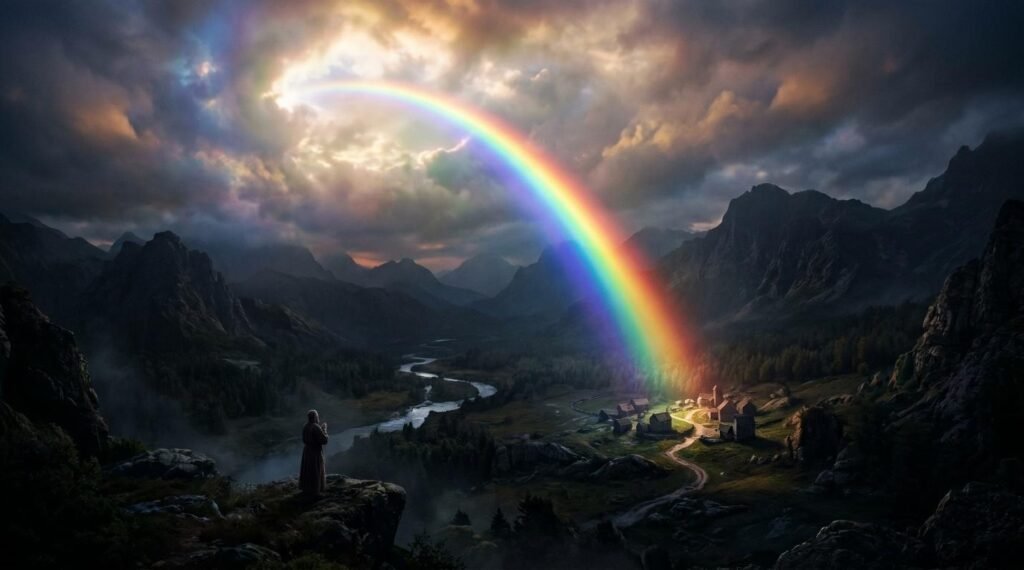
A rainbow asks nothing of us. It demands no admission, exacts no payment, requires no worthiness in the one who sees it. It simply appears—free, unearned, thrown across the sky after the storm for anyone who happens to look up. I have come to think this is no small part of why the rainbow moves us so. We are looking, whether we know it or not, at a picture of grace: something good given freely to people who did nothing to deserve it. And that, as it turns out, is precisely what the Bible means by the rainbow.
I have written before about how rarely the rainbow appears in scripture and how its handful of appearances are arranged. Here I want to dwell not on the counting but on the meaning—on what the rainbow symbolizes, and why that symbol speaks so directly to the grace God extends toward a guilty earth. For the rainbow is the oldest visible sign of grace God ever gave, and its symbolism runs deeper than the colors suggest.
A Sign Given to a Guilty World
To understand the rainbow’s symbolism, we have to begin with an uncomfortable truth, because grace means nothing apart from it. The first rainbow appears in the aftermath of the Flood—God’s judgment upon a world grown thoroughly corrupt. And when the waters recede and God sets His bow in the cloud, He is not congratulating a world that has reformed itself. He is extending mercy to a world that has not.
This is the part we must not soften. We remain sinful and guilty in every intent of our hearts; the Flood was not an overreaction. It is by grace, and grace alone, that the earth is not again judged, found wanting, and destroyed. The rainbow is the symbol of that grace—a sign that the God who could justly judge has chosen instead to be merciful. And it is worth noticing where the concept of grace first surfaces in scripture: in the very account of Noah, of whom it is written that he “found grace in the eyes of the Lord” (Genesis 6:8). Grace and the rainbow are bound together from the beginning. The bow in the clouds is grace made visible, hung over a guilty world as a promise.
That is the foundational symbolism: the rainbow stands for God’s grace toward an undeserving earth. Every other appearance of the bow in scripture builds on this first meaning, framing the glory of God with the color of His mercy.
The Arithmetic of Grace
Here the symbolism deepens in a way I find irresistible, because it connects the rainbow to the larger pattern of meaning that runs through scripture’s numbers.
The rainbow is the sign of grace, and grace, in the language of biblical numbers, is five. Five is four plus one—the number of the earth with one added. Sit with that construction, because it is the gospel in arithmetic. Four, as Bullinger observed, is the number of the world, and so it represents man’s weakness, his helplessness, his vanity. But four plus one is something else entirely: divine strength added to and made perfect in that weakness, omnipotence combined with the impotence of earth, divine favor uninfluenced and invincible.
There is the symbolism of grace in a single sum. To a fallen earth—four, weak and helpless and unable to save itself—God adds one thing the earth could never supply: Himself, His strength, His unearned favor. The result is five, grace. And this is exactly what the rainbow pictures. The earth, guilty and deserving of judgment, receives from heaven the one thing it could not produce: mercy. The bow arcs from the sky down toward the ground precisely because grace always comes from above, added to an earth that has nothing of its own to add.
I think of David choosing five smooth stones before he faced the giant—five, the number of grace, signifying his own perfect weakness supplemented by divine strength. He was stronger in that weakness, armed with grace, than in all the armor of Saul. The rainbow preaches the same truth on a cosmic scale. Earthly weakness plus divine favor equals deliverance. Grace is the “plus one” that heaven adds to the helplessness of earth.
Even the sacred recipes of the Law carry this signature. The holy anointing oil that consecrated the priests and the furnishings of the tabernacle was composed, by God’s own instruction, of five parts—and Bullinger noted that this five is marked by the very numbers four and one, for four of its components were spices and one was oil (Exodus 30:23–25). A revelation of pure grace, mixed by the formula of four plus one. The pattern is consistent enough to be unmistakable: wherever grace appears, the arithmetic of the earth-plus-one is rarely far behind. The same God who set a four-plus-one bow of mercy in the sky blended a four-plus-one oil of grace for His sanctuary. He seems to delight in signing His grace with the number that joins heaven’s one to earth’s four.
Grace That Frees Us From Fear
The symbolism carries a further dimension, one that touches the deepest instinct of the human heart. For grace, in scripture, is the answer to fear.
Human nature, at its root, is fear. We have been afraid since Adam hid himself in the garden and answered God, “I was afraid.” Fear is the dark manifestation of our fallen will, the basest instinct of the earthly creature. And here the symbolism of the rainbow does its quiet work. The God who sets His bow in the cloud is saying, in effect, do not be afraid—the storm has passed, the judgment is stayed, mercy holds. The sign of grace is, at the same time, the calming of fear.
This is the intersection at which the whole gospel stands. The proper fear of the Lord—that reverent awe which is the beginning of wisdom—is what frees us from every lesser fear. By choosing to fear God rightly, we are released by His grace from the fear of the world. Truth and grace meet here: truth requires that we fear God alone; grace protects us from the fear of everything else. And both met perfectly at the coming of Immanuel, who was, as John says, full of grace and truth (John 1:14). The rainbow over the receding floodwaters and the child in the manger are signs of the same thing—God’s grace reaching down to a fearful, guilty earth, saying, “Do not be afraid.”
Grace Available to the People of Earth
There is one more layer to the symbolism, and it is a generous one. The rainbow is not a private sign given to a chosen few; it is hung in the open sky, visible to all, a sign of grace for the whole earth.
This is fitting, for grace was always meant to reach the nations. The bow is set “between God and the earth”—not between God and one favored people, but between God and the whole created world and every living thing upon it. Its placement in the heavens, where anyone may look up and see it, symbolizes that this grace is manifest in creation and available to the people of earth. No one is too far away to see a rainbow. No one is too guilty to be offered the grace it signifies.
I find in this the same expansive heart that runs through the whole story of Immanuel—a Savior who came not for one nation but as a light to all peoples, a grace prepared in the presence of all the world. The rainbow, arcing across the sky for every eye, is an early sign of that worldwide mercy. Grace given freely, to all the earth, with nothing required of the one who receives it but to look up and believe.
Conclusion
The biblical symbolism of the rainbow is, at its heart, the symbolism of grace toward the earth. It appears first over a guilty world spared from judgment, the visible sign that God has chosen mercy—grace, the concept that first surfaces when Noah found favor in the eyes of the Lord. It pictures the very arithmetic of grace, four plus one: divine strength added to and made perfect in earthly weakness, the one thing heaven supplies that the earth cannot. It answers the deepest fear of the human heart, the bow in the cloud whispering “do not be afraid.” And it is hung in the open sky for all the world, a sign that this grace is available to every person on the earth.
I hold the particulars of number meaning with an open hand, as I always do. But the symbolism of the rainbow I hold with gladness, because it tells me the truest thing I know: that God is gracious to the undeserving, that He adds His strength to my weakness, that He stills my fear, and that His mercy is offered freely to all. The next time a rainbow stops you in your tracks, remember what you are seeing. It is grace, arcing down from heaven to a guilty and frightened earth—the same grace that came, at last, all the way down, and was born in Bethlehem. Let us count the ways.
Dr. David Elliott
Science & Scripture
Recent Comments