
Open any box of Christmas decorations and you will find them: angels on the tree, angels atop the steeple, angels trumpeting from greeting cards and choir lofts. We have made them so ornamental that it is easy to forget they are, in scripture, anything but decorative. Angels are not seasonal furniture. They are the messengers and agents of the King of heaven, and in the accounts of Immanuel’s coming they move with a precision and an order that I find more wonderful than any tinsel.
I noticed it first by accident, while counting other things. The angels who attend the life of Jesus do not appear at random. They appear nine times—and nine, as I have come to understand it across the whole of scripture, is the number of the Kingdom of God, the number of completion and divine finality. When I saw that count, I stopped treating the angels as background. They are, it turns out, the surveyor’s marks of the Kingdom, and following them is one of the surest ways to track what God is doing on the earth.
Angels Are Kingdom Markers
Let me begin with the perspective that makes sense of everything else. Angels, in the biblical record, are reliable markers of the orderliness of God. Their appearances are not haphazard; they outline the scaffolding of the Kingdom’s movement through history. They are harbingers of God’s will and executors of His Kingdom plan upon the earth. When you want to know where the Kingdom is advancing, watch where the angels are sent.
This is why I have come to read angelic appearances the way a navigator reads buoys—as fixed points that mark a channel. The angels are not freelancers; they are dispatched, and they are dispatched on Kingdom business. So when nine of them appear across the life of the Savior, the number is not incidental trivia. It is a signature. Nine, the Kingdom number, certifies that the coming of Immanuel is a Kingdom-sanctioned event—heaven’s own undertaking, sealed with heaven’s own number.
It is fitting, then, that one of our oldest carols sends us straight to the angels when we want to begin thinking about the Kingdom. “Angels we have heard on high, sweetly singing o’er the plains,” we sing, and the carol is wiser than we often notice. The plains it speaks of are the fields outside Bethlehem—earth, the kingdom of four—and the singing comes from on high, from the Kingdom of nine. The carol places us at the very seam where heaven meets earth, and it is the angels who occupy that seam. They are the ones who cross it, carrying the King’s word down to the ground. To begin a study of the Kingdom number with the angels, as I do, is simply to follow where the carol already points.
Nine Appearances, in Perfect Order
Here is the count itself, drawn from the Gospels: angels appear nine times during the advent, birth, ministry, and resurrection of Jesus. And as is so often the case with listings of nine in scripture, the nine fall into a beautifully ordered arrangement—three groups of three.
Three times to announce His coming. Before the child is born, an angel appears three times to prepare the way: to Zechariah in the temple, foretelling the birth of John the Baptist (Luke 1:11); to Mary, with the announcement that she would bear the Son of God (Luke 1:26–27); and to Joseph in a dream, telling him not to fear taking Mary as his wife (Matthew 1:20–21). Three heralds, three messages, the Kingdom announcing its arrival.
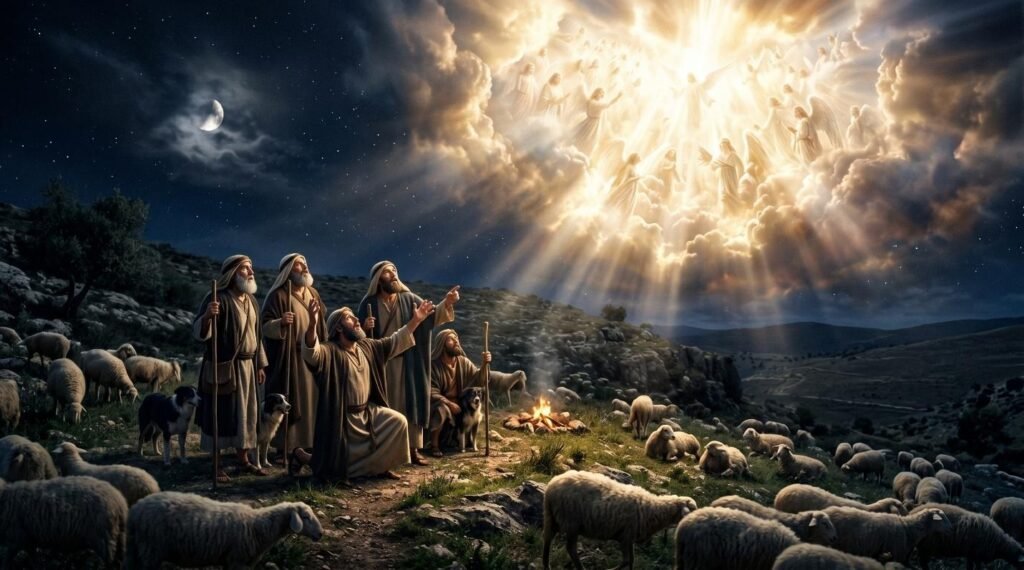
Three times during His infancy and childhood. Once the child has come, the angels appear three more times: to the shepherds in the field, proclaiming the birth (Luke 2:9); to Joseph, warning him to flee with the child to Egypt (Matthew 2:13); and to Joseph again, telling him it was safe to return to Israel (Matthew 2:19–20). The Kingdom’s newborn King is guarded and guided by heaven’s own couriers.
Three times during His ministry years. And as the Savior takes up His public work, the angels appear a final three times: ministering to Him after His temptation in the wilderness (Matthew 4:11); strengthening Him in His agony in the garden (Luke 22:43); and announcing His resurrection at the empty tomb (Matthew 28:2–3). From the wilderness to the garden to the grave, the Kingdom attends its King.
Three triads. Three plus three plus three. Nine. The completeness of the Kingdom number, distributed with an order that I cannot believe is accidental.
The Deeper Math: Three Plus Six
But the nine yields more when you look again, and this second reading is the one that turned my counting into worship.
Take the same nine appearances and divide them differently—not into three triads, but into a three and a six. Three of the appearances come before His birth, foretelling His coming: to Zechariah, to Mary, to Joseph. The remaining six come during His earthly life: three in His infancy and childhood, and three in His adult ministry years. Three to announce; six to accompany.
Now recall what these numbers mean. Three is the number of divine perfection, the number of God Himself. Six is the number of man. And here the angels are preaching by their very arithmetic. Three times they prepare the way for One who is divine—the Son of God, come from heaven. Six times they minister to One who has taken on our humanity—a man, walking the earth, hungering in the wilderness, sweating in the garden, laid in a tomb. Three for His divinity; six for His humanity. The angelic appearances themselves declare that the Savior is both God and man, fully divine and fully human, and that the two are joined in the single life they attend.
I never tire of this. The same nine appearances tell the story two ways at once—three triads proclaiming the completeness of the Kingdom, and a three-plus-six declaring the two natures of the King. The angels are not merely present at the great moments. By their number and their pattern, they are testifying to who this child is.
The Tenth Appearance and the Covenant
There is a tenth appearance, and it is worth a moment, because it rounds out the picture in a way that fits the numbers exactly.
Just after Jesus ascends into heaven, as the disciples stand gazing up after Him, angels appear once more—the two men in white who promise that this same Jesus will return as He departed (Acts 1:10–11). That makes ten. And ten, throughout scripture, is the number of covenant, the number that appears when God’s covenant love is being fulfilled. So the tenth angelic appearance, coming right at the threshold between the Lord’s earthly ministry and the age of the church, certifies God’s covenant love—now extended outward, toward all the nations.
The arithmetic is tidy in a way I find moving rather than merely clever. Nine appearances complete the account of Immanuel’s earthly life—the Kingdom number, full and finished. Then a tenth appearance opens the next chapter, the covenant promise carried out to the ends of the earth. The angels mark not only the coming of the King but the launching of His mission to the world.
What the Angels Teach Us
I want to be careful here, as I always try to be, not to claim more than the text will bear. I hold these patterns with an open hand, aware that the references disagree on many points and that I am no final authority on the meaning of numbers. A skeptic by temperament, I distrust any reading that has to strain. But the order in these appearances does not strain; it lies open on the surface for anyone willing to count.
And what it teaches, finally, is a matter of perspective. We are accustomed to reading the Christmas story for its tender human details—the manger, the swaddling cloths, the young mother. Those details are precious and true. But the angels insist that we lift our eyes higher, to the Kingdom dimension of what is happening. Every angelic appearance is heaven breaking into earth, the Kingdom of God touching the kingdom of this world. Nine times over, in perfect order, heaven declares that the birth, life, death, and resurrection of Jesus are no local event but the central act of the King.
Conclusion
The angels of the Christmas story are not ornaments, however we have used them. They are the markers of the Kingdom, dispatched on the King’s own business, and they move with an order that bears His signature. Nine times they appear across the life of Immanuel—three to announce His coming, three to guard His infancy, three to attend His ministry—the Kingdom number, complete and ordered into three perfect triads. Divide the nine again and they preach a second sermon: three for His divinity, six for His humanity, the two natures of the King declared by the very count of His couriers. And a tenth appearance, at the Ascension, seals the covenant and sends the promise to the nations.
So the next time you set an angel atop the tree, perhaps pause a moment over it. It is a small reminder of a vast truth: that when the Kingdom of God came to the kingdom of this world, heaven did not send the news quietly. It sent messengers, in order and in number, nine times over, to mark the coming of the King. Let us count the ways.
Dr. David Elliott
Science & Scripture
Recent Comments